

Designing for Wellness: How Your Home Affects Your Health
The spaces you live in are shaping your health — whether you've designed them to or not.
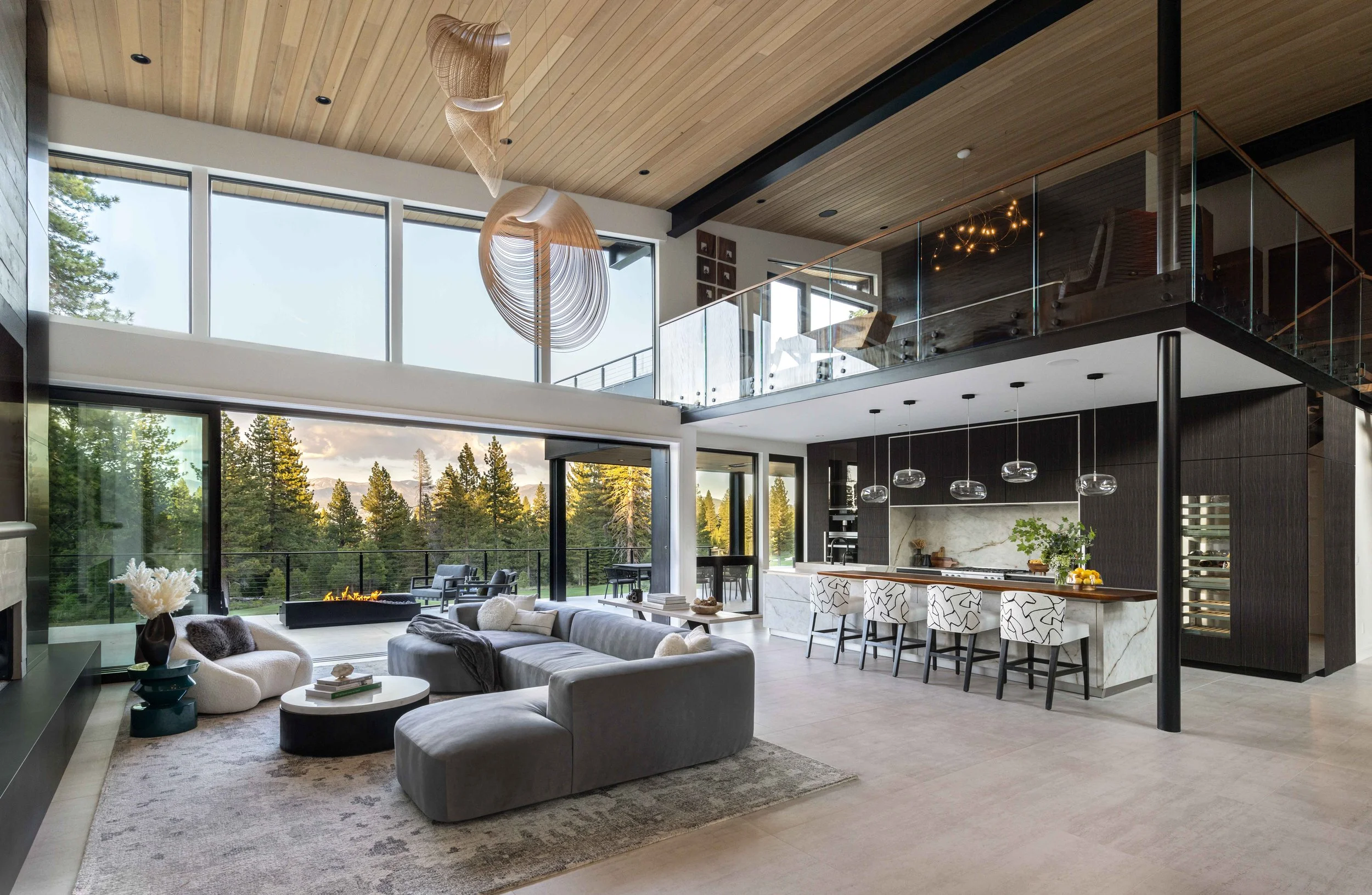
A great room with ample natural light, natural materials, and patterns.
Photographer: Kat Alves
Interior Designer: Emily Roose
Your home is the one environment you have the most control over — and it's quietly shaping your health every day. From the air you breathe to the light you wake up to, the design choices in your space affect your body, your mood, and your ability to rest and recover. As designers, we think about this constantly. Not just how a room looks, but how it performs for the people living in it.
It Starts With What You Can't See
The materials in your home are either working for you or against you. Many conventional furnishings, paints, and flooring products release volatile organic compounds (VOCs) — chemicals that off-gas into your indoor air, sometimes for years. Considering that most of us spend roughly 90% of our time indoors, the quality of that air matters more than we tend to think. Headaches, fatigue, respiratory irritation — these can all be tied to what's in the air inside your own home. The fix isn't complicated, but it does require intention. Take paint, for example. Most people know to look for "low-VOC" on the label, but the technology has gone well beyond that. Sherwin-Williams' SuperPaint with Air Purifying Technology doesn't just have low emissions — it actively eliminates VOCs and odors already present in your home, reducing compounds released by carpet, cabinets, and fabrics. Their Harmony line takes it further with formaldehyde-reducing technology that improves indoor air quality over time, plus antimicrobial agents that inhibit mold and mildew growth on the paint surface. These aren't specialty products you have to hunt down. They're readily available — you just have to know to ask for them. The same thinking applies across every surface in your home. Solid wood and natural stone over engineered composites. Fabrics made from organic or untreated fibers. Proper ventilation that allows fresh air to circulate rather than trapping stale air inside a sealed envelope. These aren't luxury upgrades. They're baseline decisions that affect how you feel every single day.
Light as a Design Material
We were meant to rise with the sun and set with it. For most of human history, that's exactly what we did. But because we live in a modern world with artificial light available 24/7, we've disrupted that natural process — and our bodies are paying for it. Natural light regulates your circadian rhythm — the internal clock that governs your sleep-wake cycle, hormone production, energy levels, and even digestion. When your home supports healthy light exposure — bright, natural light during the day and minimal artificial light in the evening — your body knows when to be alert and when to wind down. Window placement, light wells, reflective surfaces, and even the orientation of a room all play a role in how much daylight reaches you throughout the day. The good news is that lighting technology has caught up to the science. LED recessed lights designed for circadian rhythm regulation — sometimes called human-centric lighting — can mimic natural daylight at 6000K+ to boost alertness during the day, then transition to warm, amber tones below 2700K at night to promote melatonin production. Many are smart-enabled with color-tuning and automatic scheduling, so the shift happens without you thinking about it. Brands like Brilli Wellness Lighting, Wala Light, The Healthy Home Shop, and NorbSmart are leading the way. But it's not just about what happens during waking hours. What happens in your bedroom at night matters just as much. That small LED on your TV. The glow from a phone charger. The standby light on a power strip. These seem insignificant, but even that faint light can be enough to disrupt your circadian rhythm while you sleep. Your body registers it — and it can prevent you from reaching REM sleep, the deep restorative stage where your brain processes, repairs, and recovers. Without consistent REM sleep, you wake up tired no matter how many hours you were in bed. Designing a bedroom for true rest means thinking about light control at every level: blackout window treatments, eliminating or concealing standby lights, and keeping screens out of the sleep environment entirely. It's one of the simplest, most impactful changes you can make.
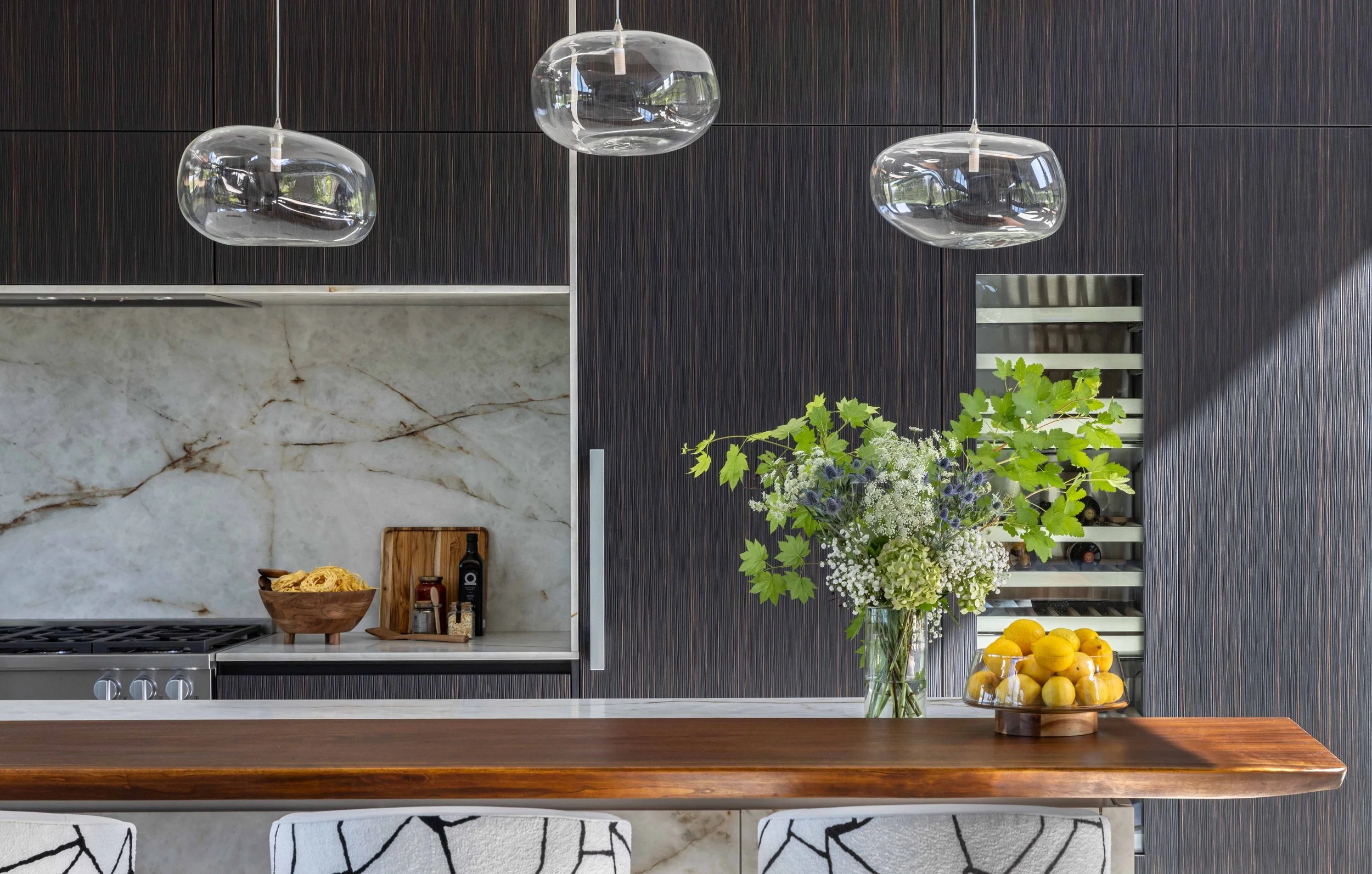
Plants, natural materials and patterns
Photographer: Kat Alves
Interior Designer: Emily Roose
Biophilic Design — More Than Plants on a Shelf
Biophilic design is a term that gets used loosely, but at its core it's about something deeply human: our innate need to connect with nature. That connection runs deeper than most people realize — and it engages far more than just your eyes. The sound of birds singing. Rustling leaves. Flowing water. These aren't just pleasant background noise — they signal safety to your nervous system and help your body physically relax. True biophilic design works on that level, engaging all of your senses to create an environment your body recognizes as restorative. There are several layers to how this works in a home:
Direct experience — physical contact with natural elements. Indoor plants, water features, natural sunlight, fresh air moving through a space. These aren't accessories. They're the foundation.
Indirect experience — materials and forms that evoke nature even when you're indoors. Timber, stone, organic patterns, natural colors in earthy tones. Your brain reads these as familiar and safe, even subconsciously.
Sensory connection — going beyond what you see to what you hear, smell, and touch. The sound of trickling water. The scent of natural wood. The feel of linen, wool, rattan, or raw stone underfoot. A room that engages multiple senses feels fundamentally different from one that only looks good.
Prospect and refuge — this is one of the most powerful and least understood principles. Humans are wired to seek out spaces that offer both long-range views (prospect) and sheltered, intimate enclosures (refuge). Think of a reading nook tucked beside a floor-to-ceiling window. That push and pull between openness and protection is deeply calming.
Natural shapes and variability — organic, flowing forms rather than rigid geometry. Subtle shifts in light and air temperature that mimic the natural world rather than the static, controlled environment of a typical modern home. These small variations keep your senses gently engaged instead of numbed.
Research consistently shows that environments designed with these principles reduce cortisol levels, lower blood pressure, improve focus, and accelerate recovery from illness. Hospitals have known this for years. The question is why we don't apply the same thinking to the places where we spend the most time.
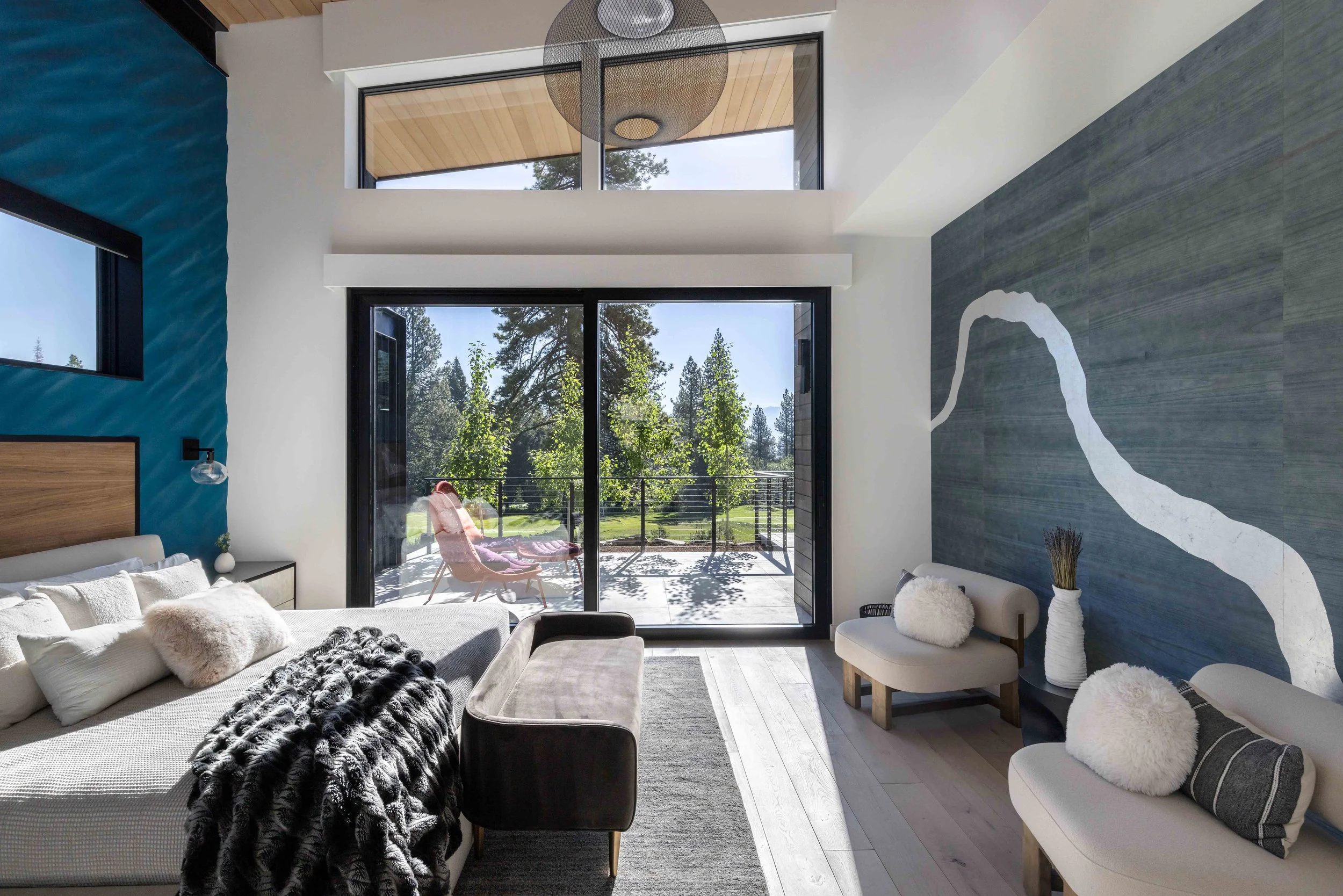
Soothing colors like blue and green and natural patterns connect us to nature
Photographer: Kat Alves
Interior Designer: Emily Roose
Color, Texture & the Nervous System
There's a difference between a room that looks beautiful in a photograph and a room that feels good to be in. Color affects mood in ways that go beyond personal preference. Cool, muted tones tend to calm the nervous system. Warm earth tones create a sense of grounding and comfort. High-contrast, saturated palettes can energize — which is great for a studio, less so for a bedroom. Texture works the same way. Smooth, hard surfaces read as sleek and modern, but an entire room of them can feel cold and uninviting. Layering in soft textiles, raw wood, woven materials, and tactile surfaces creates a sense of warmth and safety that your body responds to even if your conscious mind doesn't register why. The goal isn't to follow a formula. It's to understand that every material and color in a room is sending a signal to the people in it — and to design with that awareness. We explored this topic in depth in Color! Who Loves Color?
Your Home as a Sanctuary
For many people, home is where they recover. From long days, from stress, from illness, from life transitions that take everything out of you. A well-designed home meets you where you are. It doesn't demand anything from you. It supports rest when you need rest, focus when you need focus, and comfort when you need comfort. That's not something that happens by accident — it's designed. This is especially true for anyone managing a chronic condition, navigating a major life change, or simply carrying more than their share of stress. The built environment either helps you heal or adds to the burden. There's very little neutral ground. Wellness in design isn't a trend. It's a foundation. And a home that's designed with your health in mind doesn't just reflect who you are — it supports who you're becoming.
If you're considering a project where wellness and sustainability are priorities, we'd welcome the conversation.

Make it stand out
About the Author
Emily Roose is the founder and principal designer of Emily Roose Interiors, an award-winning luxury design studio based in Franklin, Tennessee. With a background in both marketing and interior design — and advanced training in biophilic, sustainability, and wellness design — Emily creates one-of-one residences that are as healthy as they are beautiful. Her work has been featured in Elle Decor, Dwell, Mountain Living, and Tahoe Quarterly, among others.
